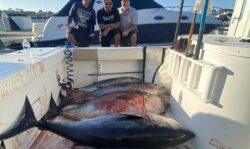
11:47 AM Breaking News / Reports: Some good news reported today. The first yellowfin and dorado were caught 200 miles below Point Loma. This is a good sign and early for this time of year.
1:22 PM Breaking News / Reports: The PCS team did a quick half day today in search of yellows on the kelp. Ryan ended up scoring a nice twenty plus forktail on our last stop of the day. The conditions are lining up for a great weekend. Keep sending us those reports!
8:54 AM Breaking News / Reports: The word is out that local yellowtail are showing up around the kelp beds off of Dana Point and a few were caught off of Abalone Point Monday morning. Good signs for any early season.
April 30
November 13
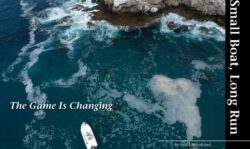
Before we could meet other fishing vessels, the fleet had headed in because of an impending storm. All day Sunday we had a gale blowing, giving us 10-18 foot seas and driving rain. In the Pacific Northwest, boarding windows come and go, as the ability to launch the small boats is impaired by the fickle weather.

October 3
February 16
-
Lone wolf spotted in CA
-
Tahoe bears make film debut
-
Tsunami relief on the Coast
-
Return of salmon
-
Return of Pacific Fishers (the animals, not anglers)
-
DFG takes on marijuana cultivators
-
Arrested poachers
-
MPA website created
-
Helped in the gulf oil spill
-
Saved some injured and trapped wildlife
Read More...
September 22
Recently, the offshore fishing on the Pacific Ocean side of Japan has extremely good for dorado, and hit and miss for the yellowfin and bigeye tuna. What is unusual is the fact that several very large yellowfin tuna have been landed close to shore, less than 10 miles from the harbors of Mie Prefecture. While there have not been many landed, there was a 209 pound specimen, taken on a topwater lure, on spinning gear only five miles off the beach.

These big fish have been following the 78 to 79 degree temperature break religiously, and moving with the Kuroshio Current up the coast. These fish are now 200 miles up the coast from where the 209 pound fish was caught.
September 22 Central Coast Fishing Update
Tuna fishing continues with albacore catches from the Rodriguez Seamount, Arguello Canyon and the Davidson Seamount. In some central coast areas, longfins are smacking trolled lures just 10 to 15 miles from the beach. Fish are running to 30 pounds, with 20 pounders the average size. Channel Islands fisherfolk are finding sporadic bites of white seabass around the east end of Santa Rosa Island and the southeast portion of Santa Cruz Island. Bounce-ballers are boating halibut from Chinese Harbor, Smugglers Cove, Christy's Ranch and Bechers Bay. Along the mainland coast, halibut are active near Rincon Point, Padero Lane, Goleta, Ellwood and Gaviota. Thresher shark are on a roll near Rock Island, Goleta, Naples Reef and Gaviota. Pier anglers are hooking into a few T-sharks along with other species of shark, they are hauling up a few halibut, scoring well on surfperch and nailing good quantities of mackerel. Read More...
January 7
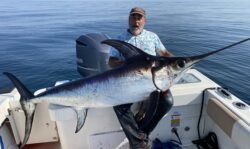
My last two trips out before the never-ending rain were memorable in different ways. I enjoyed a gorgeous early December day with my friend Greg, who introduced me to saltwater private boat fishing many years ago. I was pretty much his deckhand and loved every minute of it, while learning the ropes. We don't fish much together anymore. So we started pounding sand in the morning, hoping for one good biter, and got it a few hours later. She went 23 lbs, the biggest halibut captured for the year. The day was filled with many smiles and laughs as we recounted our numerous adventures together. I guess the smile says it all!
.jpg)
October 18
Question: The problem I have at the moment is driving me crazy! I am having a bit of bother with one of my Penn 525 mags. It's the original one that I have had for a good few years but has been well looked after and serviced by myself. Basically the last 2 trips out it has started screaming intermittantly through the cast! Some casts not at all and other casts it will start halfway through as it starts to drop out of the sky. It's sounded like the ratchet vibrating on or engaging. At first as when I fiddled with the ratchet button mid cast it would stop the screaming. Problem solved I thought ! I sanded the ratchet pawl down to nothing so that it cannot engage but next trip out exactly the same. I am using braid on this reel and I know It does not come off as smooth as mono so this may well be making things worse ? However I used it all last year with no bother at all with the same line so it's not the only cause. Bearings are fine and everything else looks to be Ok so what could it be? It can't be anything bad like a bent spindle or else it would do it all of the time. Could the bearing inners be turning on the spindle maybe? Could it be the nylon bearing retaining clip/ratchet cog catching on something?
October 15:

When we think of bluefin tuna out here on the West Coast we often think of nice 30 to 40-pounders with the occasional 100-pounder and that’s a nice fish--don’t get me wrong. When the guys on Prince Edward Island think of a nice Bluefin, they are thinking something in the 900 to 1000-pound range.
April 11:

Picture yourself hooking into a grander blue marlin off the coast of some exotic island. You’re in for the fight of your life, but halfway through the battle you decide to take a dunk overboard to get a better view of the magnificent creature’s anatomy. Once the scene is recorded onto tape for the television show you produce and seared into your memory as a basis for your artwork, you surface, continue to help leader the fish, and ultimately tag and release it.
Back on land, you recall your intrepid encounter and begin expertly painting new designs that will eventually end up as T-shirts on the backs of thousands of your fans, hang proudly as fine art pieces in their offices and homes, and even be published in a book you’re writing that will someday be honored by a foreign government.
But you don’t have time to ponder future achievements. You must immediately begin using your Ph.D. skill set to track the satellite tag on your marlin with the help of world-renowned marine scientists who collaborate with your nonprofit organization. This data will help shape the future of the oceans’ great pelagic species and provide countless joys to a new generation of responsible anglers. Oh, and you’re also very lucky: there are two giant marlin you’ll need to track because you hooked and released a second grander later that same afternoon.
Sound like fiction? Welcome to the wonderful, very real world of Guy Harvey. While Guy might not complete all of those amazing feats in a single day, these are true-to-life events experienced by this extraordinary artist, biologist, author, photographer, documentarian, conservationist, and savvy businessman.
Inducted into the IGFA Hall of Fame in 2009, Guy Harvey has built a vertically integrated oceanic-inspired empire through good old-fashioned hard work, passion, and uncanny vision. His deal making with like-minded individuals and companies has created a synergy that we all benefit from.
Pacific Coast Sportfishing was fortunate enough to snag some time with this affable tenth-generation Jamaican and learn more about the man behind the instantly recognizable signature.
PCS: Where to begin with someone who has such a rich history in the world of fishing…Do you remember the first fish you ever drew or painted?
Harvey: I honestly don’t, but I’m looking at some old sketches I did some time ago and it’s a good mixture of game fish; Wahoos, Tunas, Barracudas, Sharks, and Billfish, of course. That whole early experience of fishing with my parents in Jamaica was always positive.
PCS: Speaking of your homeland, being a 10th generation Jamaican (of English descent) must have special importance in your life. What was your favorite part of growing up on the Island?
Harvey: I think being so close to all the wonderful natural things that Jamaica has to offer. It’s a very beautiful country with lots of mountains and great forests and all kinds of different climates. It’s a bit like the big island of Hawaii, actually, and I was always impressed with the birdlife, the farm animals, and the fishing was just an extra bonus.
PCS: So did you do a lot of fishing with your parents as a youngster?
Harvey: Yes, both my parents were very keen anglers, of course my dad a bit more than my mom, but they fished tournaments, Billfish stuff, lots of river fishing. It was just a great time and place to be a kid.
PCS: In 1985 you depicted “The Old Man & The Sea” through 44 incredible pen and ink drawings and exhibited them in Jamaica. Did you ever think you could take your artistic talents, and not only make a living, but also create a full-blown empire from your marine inspired art?
Harvey: Obviously, I didn’t know the full extent. I knew there was inherent talent. A lot of other family members were very accomplished artists. I sold a few pieces here and there for a few dollars—maybe $15 to $20. Of course, in those days it was a lot of money. I didn’t really appreciate the opportunity until Americans began fishing Jamaica in the tournaments in the mid 1980s. I would have these informal expeditions at the tournaments and I would often sell out of the pieces. Once I came to the Fort Lauderdale Boat Show in 1986, I realized that here was an opportunity because there just wasn’t much of that genre readily available to people.
PCS: So when and how did your artwork end up on being printed on t-shirts?
Harvey: In 1986 I had signed a contract with T-shirts of Florida, which was then owned by Raleigh Werking, who is a good friend of Bill DePriest Sr., and he ran the company for a couple of years and got me going with the T-shirt deal, which was an instant success. There had been nothing else like it available in the market and, unfortunately, he sold the company in 1989 to his partner. And his partner continued to run the company and we had a license for another fifteen years before AFTCO came along.
PCS: How did you transition to doing business with AFTCO?
Harvey: While T-Shirts of Florida did a good job, we realized we could have expanded the line away from just T-shirts and more into sportswear. AFTCO came along in the early 2000s, and it was Milt Shedd, Bill Shedd’s dad, who came to me and said, ‘We’ve got the Bluewater Line going quite well, but something is missing. We need to include some really good art. How about a licensing program whereby you do some artwork for us?’ At the time, I was still married to T-shirts of Florida so I couldn’t do anything in the T-shirt line, but we did find a way to do some of the Hawaiian-style, all-over prints on shirts. That was early 2002, and the contract with TSF expired in 2004. Realizing what a great job AFTCO was doing in terms of the manufacturing side of it, but more importantly the marketing side of it, I saw them as a much better option. In 2004, I did fifty brand-new designs for AFTCO just so they could start with a fresh palette, so to speak, and off we went. In two years, AFTCO tripled our business, and in 2011 we’re a major brand and doing very well. The thing about AFTCO is that they are a very like-minded company to my company in terms of their whole business philosophy and the involvement of conservation efforts.


.jpg)


.jpg)